




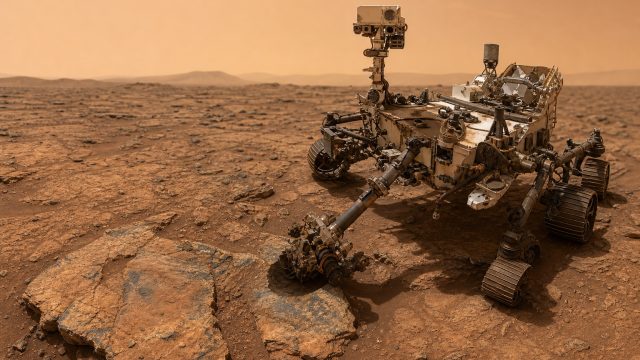
In a groundbreaking development that could reshape our understanding of the Martian landscape, NASA's Perseverance rover has discovered compelling signs of ancient life on Mars. This latest discovery, featuring complex carbon compounds, may hold the key to understanding whether life ever existed on our neighboring planet.
The Discovery: A Closer Look at Complex Carbon
In an announcement made in September 2025, NASA revealed that Perseverance collected samples from a rock on Mars, intriguingly named Cheyava Falls. The samples contain one of the most promising potential biosignatures detected to date, suggesting the presence of ancient water and organic carbon. These elements are crucial in the search for life, as they are fundamental building blocks for biological processes.
What Are Biosignatures?
Biosignatures are indicators that point to past or present life forms. They can take various forms, including:
- Organic molecules, such as carbon compounds
- Fossils or preserved remains
- Isotopic ratios that indicate biological processes
The identification of complex carbon in Martian rocks serves as a significant marker in determining the planet's habitability and the possibility of ancient microbial life.
Why This Matters Now
As humanity continues to explore the cosmos, the implications of finding evidence of ancient life on Mars are immense. With ongoing advances in technology and understanding of astrobiology, this discovery could influence future missions and research priorities. Here are a few key points highlighting the significance of this finding:
- Understanding Life Beyond Earth: Establishing whether life ever existed on Mars could provide insights into the existence of life elsewhere in the universe.
- Guiding Future Missions: The data from Perseverance can help shape the focus of future Mars missions, including potential manned explorations.
- Technological Advancements: Each discovery fuels improvements in space exploration technology, enhancing our capabilities for studying other celestial bodies.
Exploring Mars: The Role of Perseverance
The Perseverance rover, equipped with advanced scientific instruments, is designed to explore the Jezero Crater, an ancient lakebed rich in geological features. This mission aims to search for signs of life, collect samples for return to Earth, and demonstrate new technologies to aid future human explorations.
The Importance of Sample Collection
Sample collection is a crucial aspect of the mission. The rover is not only analyzing the surface but also preparing for future retrieval missions that will bring Martian samples back to Earth for in-depth analysis. This could lead to groundbreaking discoveries regarding the planet's history and the potential for life.
Conclusion: A New Chapter in Space Exploration
NASA's Perseverance rover has taken a significant leap forward in our understanding of Mars. The recent findings from the Cheyava Falls rock formation suggest that the planet may have once harbored life. This discovery not only excites scientists and space enthusiasts but also inspires a new wave of exploration and research. As the quest to uncover the secrets of our universe continues, findings like these remind us that we are just beginning to scratch the surface of what lies beyond our planet.
The implications of these findings are profound, encouraging humanity to push the boundaries of exploration and challenge our perceptions of life in the universe. With each discovery, we come closer to answering the age-old question: Are we alone in the universe?
